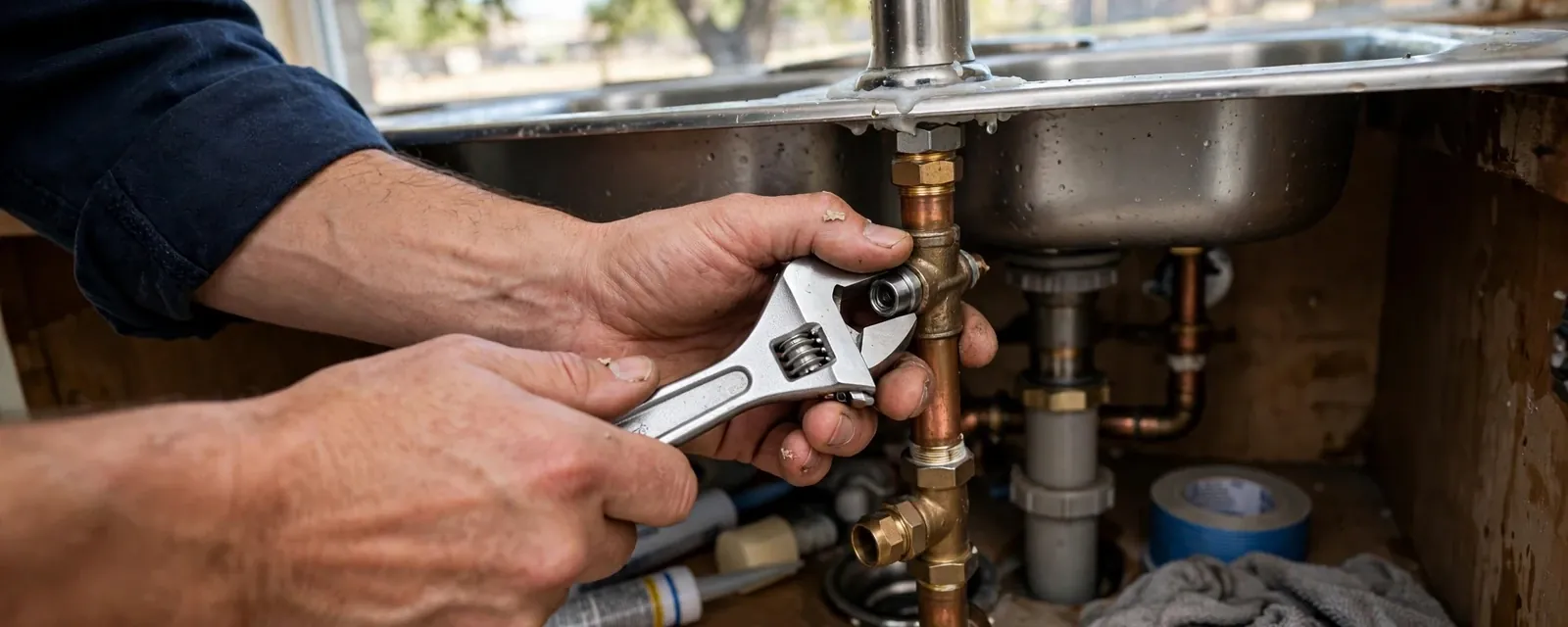
Outdoor faucets are also called hose bibs or spigots, and they have a hard life. They sit in sun and rain, take hose pressure and get yanked by garden hoses. A drip that starts small can waste water for weeks before anyone looks closely.
The first job is to notice where the water appears. That spot tells you whether you have a ten minute repair or a pipe leak inside the wall.
Read the leak before you touch the tools
Drip from the spout when it is off
Water keeps falling from the nozzle after you shut the handle. That points to a worn washer or seat inside the faucet, which is the most common outdoor faucet fault.
Leak behind the handle when it is on
Water oozes around the stem when you open the faucet. A loose packing nut or a worn packing washer is usually responsible, and it is often the easiest fix.
Spray from the vacuum breaker
Many hose bibs have a small cap near the spout called a vacuum breaker. It lets a little water out by design when the faucet is running, but it should not leak constantly. Leaks there can mean a worn part.
Water at the wall or under the siding
Dampness where the pipe enters the house, a soft patch of siding or a wet crawlspace points to the pipe behind the faucet. That is no longer a simple faucet repair.
Leak at the hose connection
A drip where the hose screws on usually means a worn rubber washer inside the hose coupling, not the faucet itself. A new washer is a small, easy part to swap.
Try this first: tighten the packing nut
If water leaks behind the handle, turn the faucet off and find the nut just under the handle. Turn it a quarter turn clockwise with a wrench, then test again. A small snug is often enough to stop a leaking stem.
Do not crank it hard. Overtightening makes the handle stiff and can damage the stem. If the nut is already tight and the leak continues, the packing inside is worn.
Step by step: replace the washer or packing
Shut the water off
Find the shutoff valve for the outdoor line inside the house, often in a basement, crawlspace or garage, and close it. Open the outdoor faucet to drain what is left in the line.
Take the faucet apart
Remove the handle screw and handle, then unscrew the packing nut and pull the stem out. Take photos as you go so you can put it back the same way.
Replace the worn parts
Swap the washer at the end of the stem and the packing washer under the nut, or wrap fresh packing string around the stem. Bring the old parts to the store so you can match the size.
Reassemble and test
Put the stem back, tighten the packing nut until snug, and reattach the handle. Turn the water on slowly, open and close the faucet, and watch for drips at the spout and behind the handle.
Check the pipe
Look at the pipe behind the faucet and the wall around it. Any dampness that stays after the faucet is fixed means a leak further back.
When the faucet is past saving
Some hose bibs are too corroded or damaged to repair. A stem that spins freely, a body that is cracked or a faucet that is loose in the wall all call for replacement. Parts for older brass faucets can also be hard to find.
Replacement is not always a quick swap. The faucet is attached to a pipe, and the pipe may be copper, galvanized steel or plastic. Each material needs a different connection method, and soldering or threading in a tight spot behind siding is not a casual job.
Frost-proof faucets have a long stem that runs through the wall so the valve seat sits inside the heated part of the house. When one of these leaks, the stem and washer are inside the wall, and you may only fix it by removing the whole faucet.
| Where the water shows | Usual cause | DIY friendly? |
|---|---|---|
| Spout drips when off | Worn washer or seat | Yes, with basic tools |
| Around handle when on | Loose or worn packing | Yes |
| Hose connection | Worn hose washer | Yes |
| Vacuum breaker spits constantly | Worn breaker part | Often, replace the cap or faucet |
| Wall or siding damp | Leaking pipe or fitting behind the faucet | No, call a plumber |
| Faucet loose or cracked | Failed body or connection | Usually a plumber job |
Millbrae pressure, older homes and what lies behind the wall
Millbrae buys all of its water from the San Francisco Regional Water System, and the city's system is split into 11 pressure zones. High pressure makes outdoor faucet washers wear faster and turns a minor drip into a steady one. If several fixtures at your house drip, ask us to check pressure before you replace parts again.
Census counts show that at least about 55 percent of Millbrae's homes were already standing by 1960. That is derived from decennial figures, not a direct survey of pipe types. In houses of that age, an outdoor faucet may sit on pipe that was installed decades ago, so a leak at the wall deserves a closer look instead of a quick patch.
If you have an irrigation system with a backflow assembly, Millbrae's municipal code requires required assemblies to be tested once a year by a tester, at the owner's expense. That test is separate from a hose bib repair, but it is worth knowing about when you see a leaking outdoor valve. Dig carefully near buried lines, and call 811 first, since all excavation requests need at least two working days' notice.
Water you cannot see
An outdoor faucet that drips only a little still matters. A drip of even one small drop each second adds up to a lot over a month, and the water goes through your meter. If your usage seems high and every fixture looks fine, a leak at the hose bib or in a buried line can be the cause.
A simple check is to close all water use in the house and look at the meter. If the dial moves, water is escaping somewhere. Close the outdoor shutoff and look again to see whether the leak sits on the outdoor line.
DIY or professional
DIY or what people try
- Wrapping tape around a leaking spout and leaving it
- Overtightening the packing nut until the handle jams
- Leaving a hose attached to the faucet through the whole season
- Ignoring damp siding because the faucet itself looks fine
Professional approach
- Replacing the faucet and checking the pipe behind it
- Testing pressure and the shutoff valve that feeds the outdoor line
- Using the right connection method for copper, steel or plastic pipe
- Tracing damp spots with leak detection instead of guessing
Water at the wall is a plumber's job
If the leak is behind the faucet, inside the wall or under the siding, call the 24/7 line before the damage spreads.
Keep the next leak from happening
Take the hose off the faucet when you are not using it. A hose left attached keeps pressure on the faucet and traps water that can strain the body. Open and close the faucet gently, and do not use a wrench on the handle.
Check the faucet each season. A quick look for drips, a stiff handle or a damp patch on the wall takes less than a minute and catches trouble early.
Getting help
Our faucet repair service handles hose bibs, indoor faucets and the shutoff valves behind them. When the leak is in the wall or underground, our leak detection team can trace it without tearing out more than needed. We work throughout Millbrae, and our Burlingame plumbing page and the service area overview show where else we go.
Outdoor faucet questions
The washer or seat inside the faucet is probably worn. Water slips past the seal even when the handle is shut. Replacing the washer or the whole faucet usually stops the drip.
Often, yes. Tightening the packing nut or replacing a washer takes basic tools. If the faucet is corroded, loose in the wall or the pipe behind it is wet, a plumber should handle it.
A little water may come out when the faucet first opens, because the breaker is designed to vent. Steady leaking while the faucet is on or off points to a worn part that needs replacing.
Look for damp siding, soft wood, stains inside the wall below the faucet or a wet crawlspace. Watch the meter with everything off. If it moves and the outdoor shutoff stops it, the outdoor line is leaking.
Even a slow drip passes through your meter and adds to the bill, and the water is gone. Call the 24/7 line for a clear price before work starts on a repair or replacement.
Millbrae's code requires testing of backflow assemblies where they are required, once a year at the owner's cost. A hose bib repair is separate. If your yard has an irrigation assembly, ask us whether its test is current.
Sources and standards: The California Plumbing Code (based on the Uniform Plumbing Code). Millbrae Municipal Code chapter 8.10 on backflow prevention. USA North 811.