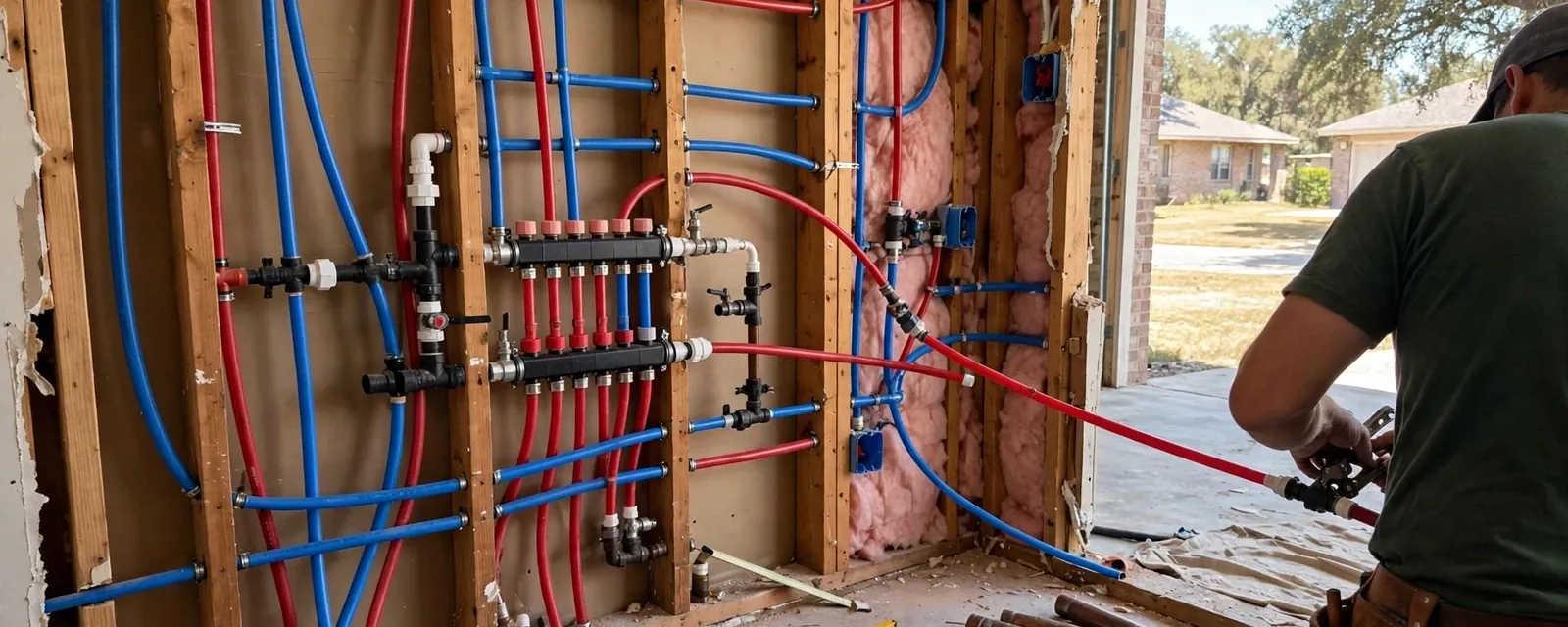
Repiping means replacing the water supply lines that run through your walls, ceilings and crawl space with new pipe. It is not a drain or sewer job, and it is not something to do over one leak. It makes sense when the pipe itself is failing, so that patching one spot only sends the next failure somewhere else.
This page explains how to tell the difference, what the work involves day to day and what to ask before you hire anyone, including us.
Signs your supply pipes are near the end
Rust-colored or metallic water
Brown or orange water from the hot tap or both taps, especially after the water has been off for a while, can mean the inside of old steel pipe is corroding. A single sample does not prove it, but a repeated pattern does.
Low pressure that keeps getting worse
Galvanized steel can narrow from the inside as mineral and rust build up. The pipe is not broken, but less water gets through, and the showers and washing machine feel it first.
Repeated pinhole leaks
A pinhole in copper is rarely a one-off. If you have fixed one and a second shows up in a different spot, the pipe wall is thinning along its length and more are likely.
Brittle or cracked plastic pipe
Some CPVC lines become brittle with age and heat and can crack at fittings. If you have found a cracked fitting, the rest of the run deserves a look.
Water bill climbing with no visible leak
A hidden leak in a wall or under the floor can run for weeks. Leak detection is the right first step because it tells you whether a spot repair will do.
Repair a section or repipe the whole house
The honest answer is often "it depends on what we find." A single failed section of copper in an otherwise sound house is a repair. A house where galvanized pipe is corroded throughout, or where several leaks have appeared in a short time, is a repipe candidate.
We look at the pipe where we can see it, check pressure at several fixtures and test for leaks before we recommend anything. If a repair will hold, we say so and do the repair. If it will not, we explain what we saw so the choice is yours.
| Pipe type | Common failure | Usually repair when | Usually repipe when |
|---|---|---|---|
| Galvanized steel | Internal corrosion, low flow, rusty water | One short section failed and the rest tests sound | Flow is poor at several fixtures or water runs discolored |
| Copper | Pinholes, failed solder joints | A single joint or a short run is the problem | New pinholes keep appearing in different places |
| CPVC | Cracked fittings, brittle pipe | One fitting failed on a young run | Multiple cracks or pipe that snaps when touched |
| Mixed old and new | Failure at transitions | The transition was never done properly | The old section is shot and the new one ends at it |
What a repipe involves
Repiping means opening walls or ceilings at strategic points, running new pipe, connecting every fixture and closing the access again. It sounds disruptive, and it can be, but good planning keeps the number of openings low and the time without water short.
Walk the house and plan the route
We look at every fixture, trace where the old pipe runs and decide which walls, attics or crawl spaces give the cleanest path. You see the plan before anything is cut.
Rough in the new lines
We run new supply pipe to each fixture, set shutoff valves and connect to the main. The water is off for part of the day, and we tell you in advance which hours.
Test, inspect and patch
We pressure-test the new lines, arrange inspection where a permit applies and patch the access openings. Paint and finish carpentry are usually separate trades, so we tell you what is left to finish.
Millbrae houses, pipes and what the city expects
Older housing and the ground it sits on
Housing data puts the typical Millbrae house at about 1958, and Census counts show that more than half of today's homes were already built by 1960. Homes that old have had a lot of time for pipes to wear, and some have been partly repiped already, which leaves mixed materials with joints where old meets new. The pipe material in any given house is a question for inspection, not for the year alone.
The San Andreas Fault lies within a mile of Millbrae's western city limits, according to the city's General Plan. Shaking moves pipes, so a repipe is a chance to use flexible piping and proper fittings that tolerate movement, and to strap and support runs properly. We explain the material choices before you choose one.
The city supplies water to Millbrae through 11 pressure zones, so pressure varies by location. A new repipe is a good moment to check pressure at the house and fit a regulator if the numbers call for one.
Repiping is permit work. Millbrae's Municipal Code requires permits for plumbing system work, and the Building Division handles plumbing permits at its counter and online. California's contractor licensing board, the CSLB, lists plumbing under classification C-36, and you can check any contractor's license on its website. The minor-work exemption is $1,000 and does not apply to work that requires a permit, so an unlicensed repipe is a risk to you as the owner.
Materials: what goes in the new walls
The common choices are copper and PEX, and each has trade-offs. Copper is rigid, long established and joined with soldered or pressed fittings. PEX is flexible, runs in long continuous lengths with fewer joints and is usually quicker to install in finished walls.
We do not push one material for every house. The right one depends on your walls, your water, your budget and what your building inspector accepts. Ask any plumber, including us, why they recommend what they recommend, and ask what the fittings are made of.
What people try first
- Patching one pinhole after another with clamps or epoxy
- Ignoring discolored water because it runs clear after a minute
- Replacing only the visible section and leaving the old pipe in the wall
- Hiring the lowest bidder without checking license or permit plans
What a proper repipe looks like
- Test the pipe and the pressure before choosing repair or replacement
- Replace the failing run end to end with a material chosen for your walls
- Plan access, shutoffs and water-off time in advance
- Pull the permit and schedule inspection before the walls are closed
What affects repiping cost
Repiping prices vary more than almost any other plumbing job, so we explain the drivers first.
House size and fixture count
More bathrooms, kitchens and laundry connections mean more pipe.
Access
Open crawl spaces and attics are quicker than finished walls and slabs.
Material choice
Copper and PEX differ in materials and labor.
Wall and ceiling patching
Opening and repairing drywall adds scope, even when it is done by a separate trade.
Permit and inspection
Fees and scheduling are part of the job.
Call the 24/7 line for a clear price before work starts. A written scope that lists what is included and what is not helps you compare bids fairly.
Not sure it needs a full repipe?
Call and describe your pipes, your symptoms and your house. We will tell you whether a repair, a partial repipe or a whole-house repipe fits what you have.
Related plumbing questions
If a pipe has already burst, our burst pipe repair page covers stopping the water and the fix. If the problem is the line from the street to the house, that is water service line repair, and it is a separate job from repiping inside the building.
We serve Millbrae and also the next-door city of Burlingame, and the service area page lists the rest of our coverage. The 24/7 line is open at any hour if a leak turns urgent before the planned work begins.
Repiping questions
A single failed joint or section with sound pipe around it is a repair. Repeated leaks in different spots, rusty water, falling pressure at several fixtures or brittle pipe point toward a repipe. We test and look before recommending either one.
It depends on house size, access and the number of fixtures, so we do not give one number. We plan the work and tell you which hours the water will be off before we start, so you can plan around it.
It involves openings, but good planning keeps them limited. We choose access points that cause the least damage and tell you where they are. Patching drywall and paint are usually separate trades, and we are clear about what is included.
Yes, repiping is plumbing system work and permits may apply. The Millbrae Building Division handles plumbing permits. The CSLB minor-work exemption does not cover permit work, so use a licensed plumbing contractor and ask to see the permit plan.
Neither is right for every house. Copper is rigid and long established. PEX is flexible and quicker to run through finished walls. We look at your access, your budget and your water, then explain the choice before you commit.
Often yes. We can see exposed runs in the crawl space, attic, garage and under sinks, and we check the meter area. The year of the house alone is not enough, because earlier owners may have replaced sections.
Close the main water valve and call. The line is open 24/7, and we can repair the leak to keep the house usable until the repipe starts. Do not wait for a hidden leak to stain a ceiling.
Sources and standards: The California Plumbing Code (based on the Uniform Plumbing Code). Millbrae Municipal Code section 9.05.060 on permits. The California Contractors State License Board (CSLB) C-36 plumbing classification.