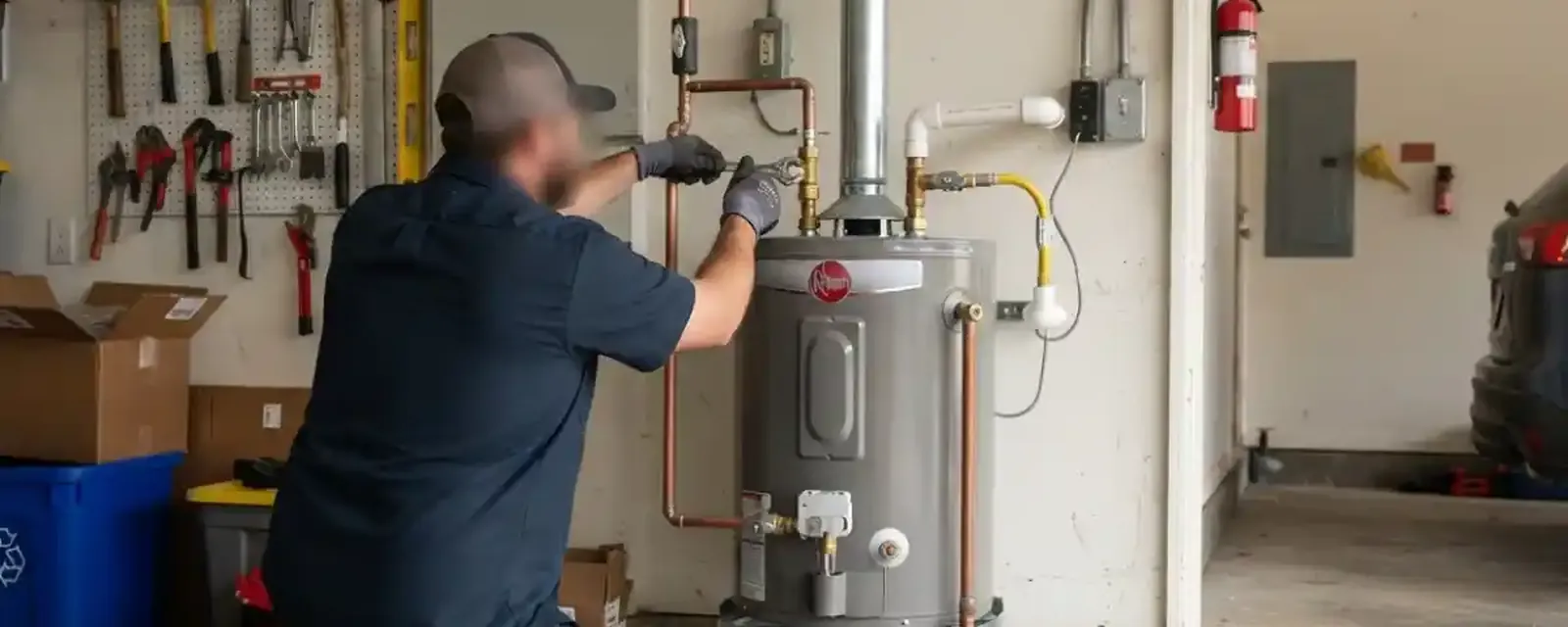
A water heater is one of the few appliances you can plan around. Replaced on your schedule, it lets you compare fuel types, check the vent and electrical supply, and pick a size that fits how your household uses hot water. Replaced in a hurry, you take what is on the truck.
This page is about the planned version of that job. If your tank is already leaking, our water heater replacement page covers urgent swaps, and the process below still applies.
Choosing size and fuel for your household
Tank size is set by how much hot water you use at the same time, not by the number of rooms. A couple with one bathroom and a household with teenagers and two showers running need very different tanks. We ask when people shower, how many baths or large tubs you have, and whether the dishwasher and washer run at the same time.
Fuel is the next decision. Gas heaters have lower running costs where gas is available and recover quickly, electric tanks are simple and need no vent, and heat pump models move heat from the surrounding air and are efficient but need space and airflow. Each has trade-offs, and the right one depends on your house, not on a general rule.
What we look at before we install
A good installation starts with the location, not the heater. These are the things we check.
Space and clearance
A tank needs room around it for service, combustion air if it is gas, and airflow if it is a heat pump. A closet that fit the old unit may not suit a taller or wider new one.
Venting for gas units
The vent must slope, seal and terminate properly. An old vent that was fine for a previous model may not match a new tank, and we check it before we connect anything.
Gas line and connector
We check the line size, the shutoff and the flexible connector, and leak test every joint. A worn connector is replaced and not reused.
Electrical supply
Electric and heat pump units need the right breaker, wire gauge and sometimes a dedicated circuit. We tell you early if the panel is a limit, so nothing surprises you on install day.
Drain, relief valve and discharge
The relief valve needs a discharge pipe routed safely. Heat pump units also need a path for condensate. We plan both before we set the tank.
Installation day, step by step
Walk the site
We look at the location, the existing connections and the path the new tank will take. Anything that needs correcting is explained before work begins.
Shut down and remove the old unit
We turn off the water and power or gas, drain the old tank and take it out. We protect the floors and remove the old tank from your property when we leave.
Set, connect and strap
The new tank is set level, connected with new flexible connectors, fitted with a relief valve and discharge pipe, and strapped against earthquake movement. Gas lines are leak tested.
Fire it up and show you
We fill the tank, light or power it, check for leaks and temperature, and show you the shutoffs. You get a clear explanation of how to maintain it.
Close out the paperwork
If a permit applies, we handle the process so the work is documented properly. We tell you what to keep.
Local rules that shape an installation in Millbrae
Millbrae has about 8,700 housing units, and almost two-thirds of them are single-family detached homes, according to the city's housing element draft. Many were built in the postwar growth that took the city from 2,783 dwelling units in 1950 to 4,803 by 1960. In older houses, the water heater often sits in a garage or closet with a vent, gas line and strapping that predate current practice, so we inspect the whole setup and not just the tank.
Millbrae's own water comes from the San Francisco Regional Water System, and the city's 2025 water quality report lists hardness averaging 62 ppm. That is on the soft side, which suits most tank and tankless heaters, though sediment still builds up over time. Plumbing permits go through the Millbrae Building Division, and permits may apply to a new installation, so ask us what your job needs.
California's Health and Safety Code section 19211 requires water heaters to be braced, anchored or strapped against earthquake motion. The San Andreas Fault is within a mile of the city's western edge, so we strap every tank we set.
Fuel and type compared
| Type | Good fit | Watch for |
|---|---|---|
| Gas tank | Homes with gas and a working vent | Vent condition, gas line size, combustion air |
| Electric tank | Homes without gas, or simple retrofits | Breaker capacity, running cost |
| Heat pump tank | Homes with space, airflow and electrical capacity | Clearance, condensate drain, noise near bedrooms |
| Tankless | Households wanting on-demand supply | Gas line, venting, descaling over time |
What the Bay Area rules and incentives mean for your choice
Bay Area rules on new water heaters are changing, and they may affect which units can be installed in your home. Ask us what applies to your installation before you buy. We would rather tell you now than have you carry a unit home that you cannot use.
Local energy programs sometimes offer incentives for electric and heat pump water heaters. Eligibility depends on your home, your current fuel and the program, and we cannot promise what you will qualify for. Check with the program before you commit, and we will help you choose a model that suits it.
DIY or what people try
- Buy the cheapest tank of the right size and hope it fits
- Reuse the old gas connector, valve and relief pipe
- Skip the earthquake straps
- Install a heat pump unit without checking panel capacity
- Leave the old vent as is when changing the model
Professional approach
- Match size, fuel and location to your household
- Replace connectors, valves and discharge piping with the tank
- Strap the tank as California requires
- Check panel capacity and airflow for electric and heat pump units
- Inspect and correct the vent before connecting gas
What affects the cost of a water heater installation
You get a clear price for your job on the phone before we begin.
Tank type and size
Gas, electric and heat pump units differ in price and in the work they need.
Venting and gas line
A new vent or a longer gas run adds time and material.
Electrical work
A heat pump or electric unit may need a new circuit or breaker.
Location
Attics, crawl spaces and tight closets take longer than a garage.
Code items
Straps, discharge piping, expansion control and permits are part of doing it properly.
Call the 24/7 line for a clear price before work starts. If a cheaper unit would serve you well, we say so, and if a pricier one is not needed, we tell you that too.
Let us plan it with you
Tell us what you have now and what you want from the new heater. We will talk through size, fuel and timing and give you a clear price.
Related work for the same project
If you are considering an on-demand unit, our tankless water heater page explains how installation differs. A new heater is also a good moment for other upgrades, and our plumbing installation page covers fixtures and new lines.
We also serve nearby Burlingame, and the service area page lists everywhere we work. Our line is open 24/7, so you can call any time to schedule.
A like-for-like tank is often done in a few hours, while a heat pump or a move to a new location takes longer because of electrical, venting or drain work. We tell you what to expect when we confirm the job.
It depends on your house. Gas is common and recovers quickly, electric is simple, and heat pump is efficient but needs space and airflow. We look at your fuel, panel and layout before recommending one.
It can. Plumbing permits come from the Millbrae Building Division, and since the city's pages say nothing specific about water heaters, we ask the division what your address needs before work begins.
Yes. Any heater we set gets earthquake straps, because California requires bracing on installed water heaters.
Some local programs offer incentives, but eligibility depends on your home, your current fuel and the program rules. We cannot promise any amount. Check the program details and ask us which units fit.
Rules on new water heaters in the Bay Area are changing. Ask us what applies to your installation so you do not buy a unit you cannot install.
Yes. Call the line and we explain the options and give a clear price before work begins. If the job changes once we open it up, we stop and discuss it with you first.
Sources and standards: California Health and Safety Code section 19211 on water heater bracing. The California Plumbing Code (based on the Uniform Plumbing Code). The California Contractors State License Board (CSLB) C-36 plumbing classification. The Bay Area Air Quality Management District. Whose rules on new water heaters are changing.