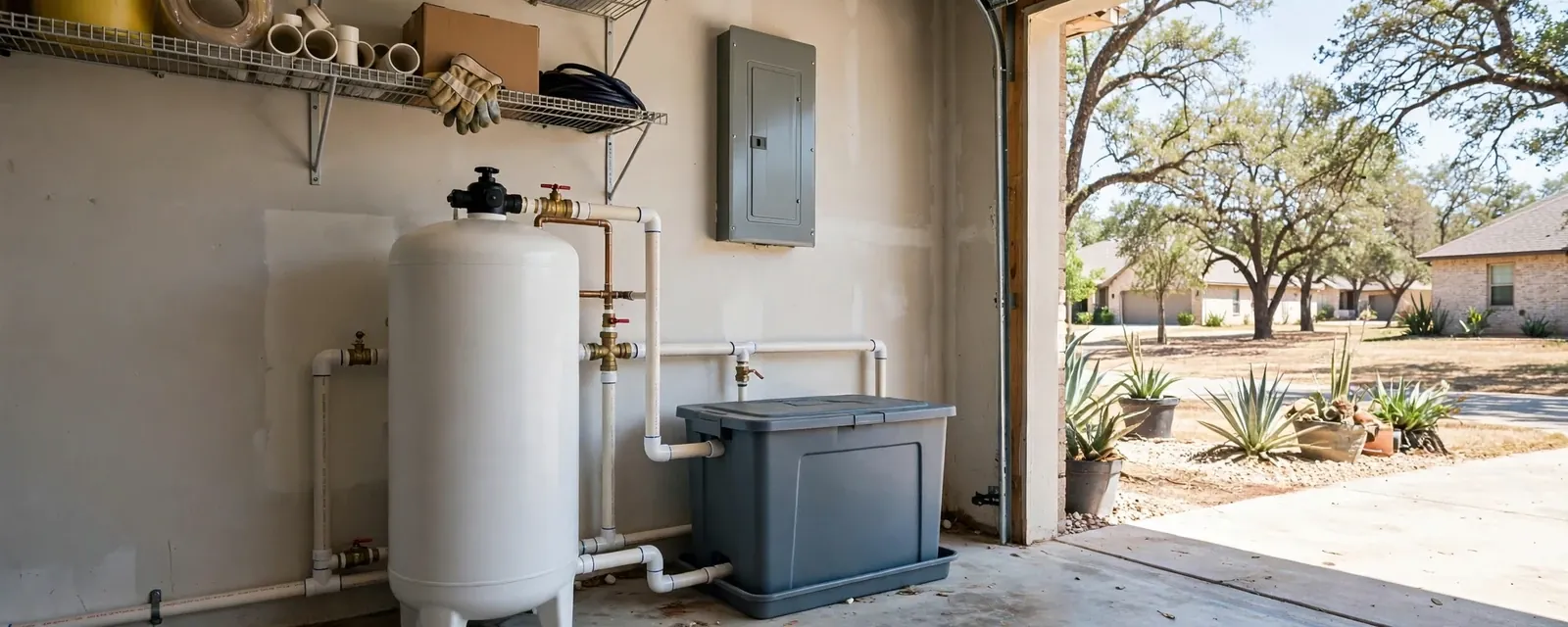
"Big Blue" is a nickname for a style of oversized filter housing, usually with a translucent or opaque blue sump and a diameter of about 4.5 inches. The name stuck because the housing is physically big and the cartridges inside it are too. More surface area means more flow and a longer gap between changes than a standard slim housing offers.
This guide skips the water chemistry and focuses on the hardware: how to choose the size, what the ports and fittings mean and where the housing should go so it can be serviced safely for years.
Slim or Big Blue: the basic choice
Standard slim housings take cartridges about 2.5 inches across. A Big Blue takes cartridges about 4.5 inches across, so the filtering surface is far larger. That matters on a whole-house line because the water has to pass through the cartridge at whatever rate your fixtures demand.
A slim housing on a full house may work, but it loads faster and drops pressure sooner. A Big Blue on a small apartment line may be overkill. The right pick follows demand and the cost of changes, not the idea that bigger is automatically better.
Ten inch or twenty inch
Housings come in two common lengths, with cartridges about 10 or 20 inches long. The longer one gives more surface, which helps flow and lifespan. It also gives water more time in contact with carbon, which is useful when carbon is the cartridge.
The tradeoff is space and weight. A twenty inch sump needs the length of itself below the housing to come off, plus room for a hand. A full twenty inch Big Blue holds a lot of water, and it is a heavy thing to hang from a wall.
| Feature | 10 inch Big Blue | 20 inch Big Blue |
|---|---|---|
| Cartridge surface | Moderate | Roughly double |
| Flow for a family home | Fine for modest demand | Better for multiple baths |
| Clearance needed below | Less | More |
| Weight when full | Heavy | Heavier |
| Change interval | Shorter | Longer |
Port size and the pipe you already have
Big Blue housings are sold with port sizes of three quarter inch and one inch. A three quarter inch port on a one inch main squeezes the flow, and the extra size of the housing is wasted. Check your incoming pipe and any pressure regulator before picking a housing.
Fittings matter as much as ports. Housings with plastic threads can crack when over-tightened or when a rigid pipe is forced into alignment. Flexible connectors, unions at each side and a short pipe stub help the housing sit without strain.
What goes on the wall, and what goes inside it
A Big Blue needs a bracket, and a full housing weighs enough that the wall behind it has to be solid. Fasten into studs, a plywood backer or masonry, not drywall anchors. The bracket should hold the housing upright so the sump can be unscrewed straight down.
Quake bracing for a filled housing
Millbrae's 2040 General Plan notes that the San Andreas Fault lies within one mile of the western city limits. A water-filled housing mounted on a wall is a heavy object that can shift or pull on its connections in a strong shake. Brace the bracket firmly and use flexible connectors so ground motion does not put the load on the plastic ports.
Millbrae water is disinfected with chloramine, according to the 2025 water quality report. If you choose a carbon cartridge for taste, the extra length of a twenty inch housing gives the water more contact time, which helps with chloramine. That is a size reason to choose the larger housing, not a promise about results.
Cartridge types that fit these housings
A Big Blue accepts sediment cartridges, carbon blocks and granular carbon, and some specialty types. The first position almost always holds sediment, so the carbon downstream does not clog. A pleated cartridge can be rinsed and reused in some cases, while wound string cartridges are replaced.
Make sure cartridge dimensions match the housing exactly. A cartridge that is a half inch too short or too narrow may bypass water around its ends and filter nothing. If a cartridge does not seat or seal, do not force it.
A sound install, step by step
Pick the location and confirm clearance
Choose a spot after the main shutoff and ahead of the first branch. Measure the housing height plus the sump drop plus a hand's width below it.
Mount, plumb and connect
Install the bracket on a solid backer, hang the housing with the arrows pointing the way water flows, and connect flexible or unioned fittings so the housing is not holding the pipe's weight.
Add valves, test and flush
Install shutoffs on both sides and a bypass, fill slowly, check every joint, then flush the cartridge before the water goes to the house.
DIY, or call a plumber?
Changing a cartridge in an existing Big Blue is simple enough for most homeowners. The housing will have a pressure-relief button on top, which is pushed to bleed air and pressure before unscrewing. A strap wrench or the plastic wrench sold with the housing handles the sump.
Installing a new one is another story. It means working on the main line, and a mistake at that point can flood the house and require a long shutoff. The Millbrae Building Division handles plumbing permits, and permits may apply. The state minor-work exemption does not cover permit work, so ask who is pulling the permit before you agree to a price.
- Confirm incoming pipe size and material before you buy
- Choose 10 or 20 inch length based on clearance and flow
- Pick a port size that matches or exceeds the pipe
- Plan a stud or backer for the bracket
- Add a bypass and two shutoffs
- Keep a spare O-ring and a set of cartridges on hand
- Write the install date on the housing
When a Big Blue is the wrong answer
If the aim is only better drinking water at one tap, a Big Blue at the main is more equipment than you need, and a small under-sink filter does the job. If scale is the concern, a filter does not soften water at all. And if you are renting, a housing bolted to a wall and cut into the main is not a decision to make alone.
For scale, hardness and softening questions, our water softener and filtration service walks through what actually fits. When the housing is part of a bigger remodel or new main line, plumbing installation can handle the rough-in and valves together.
Neighbors in the next town can reach us as well, as our Burlingame plumber page explains. The service area page lists where else we go. If a connection starts spraying or a housing cracks, shut off the main and call the 24/7 line right away.
Not sure about size?
Call the 24/7 line and tell us your pipe size, your space and how many bathrooms you have. We will recommend a length and give a clear price before work starts.
It moves more water and holds a larger cartridge, which helps whole-house flow and change intervals. For a small household or a single tap, a standard housing can be a better and cheaper fit. Match the size to the demand.
Possible, but shade and freeze protection matter. Sunlight can damage the sump and cold nights can crack a water-filled housing. If it has to go outdoors, plan an enclosure and insulation.
Usually a dirty or pinched O-ring, or a sump that is not seated. Clean the groove, use a thin film of food-safe silicone lubricant, and hand-tighten with the wrench. Overtightening can crack the housing.
Open a downstream faucet, then slowly open the inlet valve and press the pressure-relief button until water appears. Trapped air clears quickly once the housing is full.
Bracing is sensible in any area near a fault. Use a solid backer, secure the bracket and add flexible connectors so the housing is not pulling on rigid pipe if the wall moves.
The General Plan places the fault within a mile of the western city limits. That does not dictate a spot, but it argues for solid framing, a firm bracket and flexible connectors so a shake does not strain the main line.
Sources and standards: The California Plumbing Code (based on the Uniform Plumbing Code). The Millbrae 2040 General Plan hazard chapter. The City of Millbrae 2025 Water Quality Report.