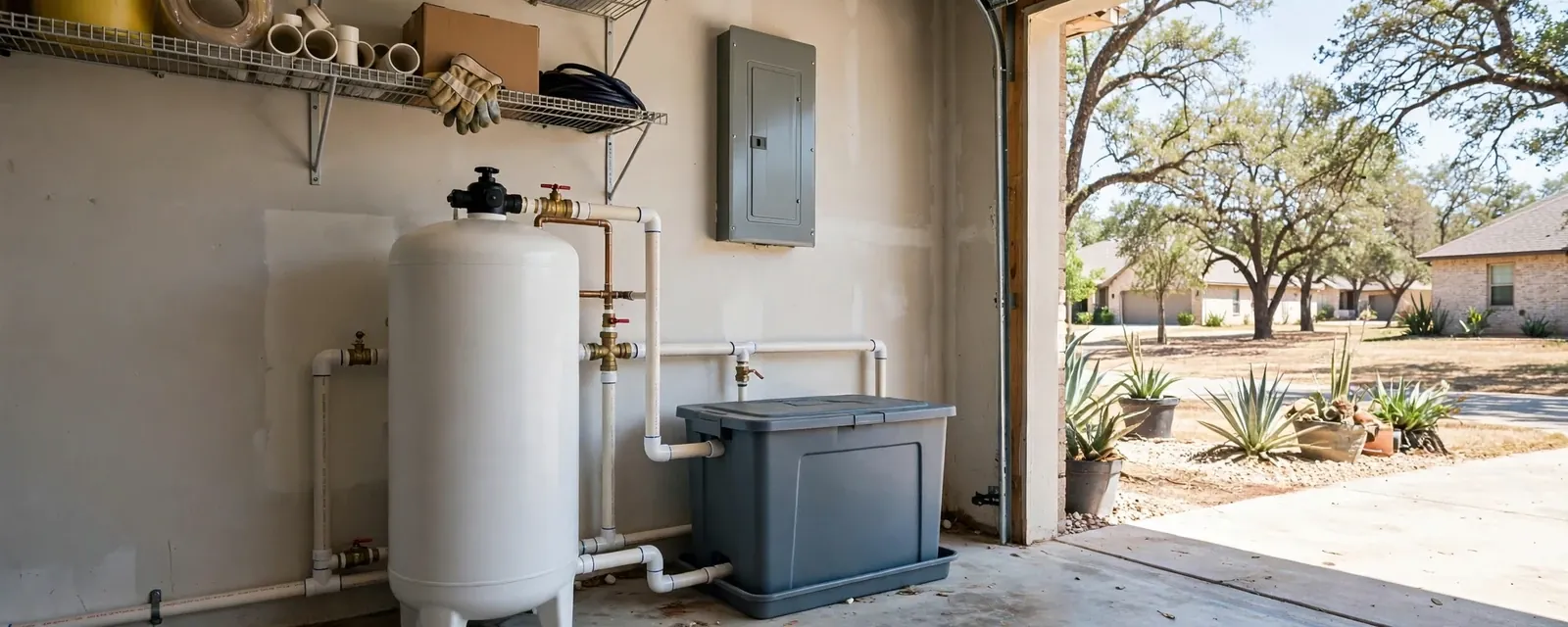
Before you buy a softener or a filter, find out what problem you are trying to solve. In Millbrae, the water most households get is already soft by common standards, so a lot of the hardness problems that drive softener sales in other parts of California do not show up the same way here.
That does not mean filtration is pointless. Some people want better taste, less chlorine smell, or protection for specific appliances. Others already own a system that has stopped working. We cover both, and we start with what your water actually is.
What is in Millbrae's water
The City of Millbrae buys its water from the San Francisco Public Utilities Commission, and the 2025 Millbrae water quality report shows the figures that matter for this decision.
| Measure | 2025 Millbrae report | What it means for you |
|---|---|---|
| Hardness (as CaCO3) | 8.1 to 112 ppm, average 62 ppm | Soft to moderately hard, mostly on the soft side |
| Hardness in grains per gallon | About 3.6 at the average (our math) | Below the level where most people notice scale |
| Disinfectant | Chloramine | Affects taste and smell, and some equipment |
| Supply source | 100 percent SFPUC | One supplier, so the report covers your tap |
The grains figure comes from our own conversion of the 62 ppm average, since the report lists parts per million only. The range matters too. A reading near the top of that range can leave more spotting than one near the bottom, so the water at your tap may sit above or below the average.
Do you actually need a softener
For most Millbrae homes, probably not, and that is not what some sellers will tell you. A salt softener exists to remove hardness minerals, and with an average of 62 ppm there is not much hardness to remove. Scale on faucets, spots on glass, and crusty showerheads can still appear, but usually in mild form.
When a softener can still make sense
If you see heavy scale on fixtures, your water heater shows mineral buildup when it is flushed, or you want softer feeling water for personal preference, a softener may still be reasonable. It is a comfort choice here, not a necessity. We will tell you if your situation does not justify the equipment.
If you are not sure, a simple hardness test strip at your tap gives you a rough number to compare with the 2025 report. That costs far less than a system, and it tells you whether the symptoms you are seeing are really hardness.
What filtration can and cannot do here
Filtration is where Millbrae's chloramine matters. Chloramine is the disinfectant the water system uses, and it does not boil off the way plain chlorine does. A basic carbon filter helps with taste and smell, but chloramine reduction usually calls for a catalytic carbon block or a good contact time, so the filter type matters.
Taste and smell
A carbon filter at the kitchen tap or under the sink is the most direct fix. It is far less expensive to install than a whole-house system and addresses what most people notice.
Whole-house carbon
Treats every tap, shower, and appliance. It helps if you notice the smell in showers or want to reduce chloramine throughout the house, and it requires proper sizing and cartridge changes.
Sediment pre-filter
Catches rust flecks and particles from older pipes. It does not change the water chemistry, but it protects fixtures and other filters downstream.
Drinking water systems
Under-sink or reverse osmosis units give the cleanest drinking and cooking water at one tap. They need an extra faucet and a drain connection.
If you keep fish, run a dialysis machine, or have another sensitive use, tell us. Chloramine matters for those, and generic filters may not be the right answer.
How we help
Start with the problem
You describe what you notice: taste, smell, spots, scale, a slow flow. We ask what is installed now and when it last got service.
Match the fix
We explain whether a softener, a carbon filter, a sediment filter, or nothing at all fits. If the answer is nothing, we say so.
Install or repair
We plumb the system with a bypass, shutoffs, and a drain connection where one is needed, so you can service it without calling us each time.
Test and show you
We check flow, pressure, and leaks at every connection, then show you how to change cartridges or refill salt.
Repairing a system you already own
A lot of calls come from people who bought a system and it stopped working. Common problems include a control head that no longer regenerates, a salt bridge, a clogged resin bed, a leaking fitting at the bypass, or a filter that has become restrictive because the cartridge was never changed.
We can service water conditioners and filters, including units installed by someone else. If a system is old and the repair cost approaches the cost of a new unit, we tell you. Given Millbrae's softer water, we also tell you if replacing a failed softener is even worth it.
What affects the price of treatment equipment
What drives water treatment cost
Costs vary widely between a single tap filter and a whole-house system.
System type
carbon filters, sediment housings, softeners, and reverse osmosis have different equipment costs.
Size and capacity
how many people and fixtures the system serves decides the tank or housing size.
Location and plumbing
an easy mounting spot with a nearby drain is simpler than a tight closet.
Bypass and extras
shutoff valves, pressure gauges, and extra faucets add materials.
Ongoing costs
cartridge changes and salt are recurring, so we talk through them before you buy.
Call the 24/7 line for a clear price before work starts. If the work touches the main supply line, permits may apply, and the Millbrae Building Division handles plumbing permits.
Not sure what your water needs?
Call and describe what you notice. We will tell you whether equipment helps and give you a clear price if it does.
Connecting water treatment to the rest of your plumbing
Treatment equipment ties into your supply line, so the cleanest installs happen when the plumbing around them is in good shape. Our plumbing installation service covers the new shutoffs, drain lines, and supply connections that a system needs.
If your hot water is part of the reason you are asking, tankless water heater service covers descaling and flushing, and water heater installation is the place to start if you are replacing a tank at the same time. We also serve nearby homes in Burlingame, and the Burlingame page has the details.
Questions about softeners and filters
The 2025 Millbrae report shows hardness from 8.1 to 112 ppm with a 62 ppm average. That is on the soft side, so many homes see little scale. Readings can fall anywhere in that range.
Often not. With soft to moderately hard water, a softener is usually optional here. If you have visible scale or want softer feeling water, one can still make sense, and we will give you an honest recommendation.
Yes, the water is disinfected with chloramine. It affects taste and smell, and it does not boil off. A catalytic carbon filter is the usual way to reduce it, and we can set that up at one tap or for the whole house.
Not necessarily. Millbrae's water is regulated and reported publicly each year. A filter mainly changes taste and smell and protects some equipment. If you have a specific health concern, talk to your doctor and review the city report.
Usually yes. We check the control head, resin tank, brine system, and connections. If the unit is near the end of its life, we tell you before you spend money on parts.
Softeners remove hardness minerals with salt-based resin. Conditioners and descalers change how the minerals behave without removing them. We explain which one a given product is, since labels can be vague.
A properly sized system should not noticeably reduce pressure, but a clogged cartridge will. We size the housing for your flow and show you when to replace the cartridge.
The City of Millbrae publishes an annual Consumer Confidence Report. The latest edition covers 2025 data and lists hardness, disinfectant levels, and test results for the water you receive.
The call line runs 24/7, so you can ask about your water whenever it crosses your mind.
Sources and standards: The City of Millbrae 2025 Water Quality Report. The San Francisco Public Utilities Commission. The California Plumbing Code (based on the Uniform Plumbing Code).