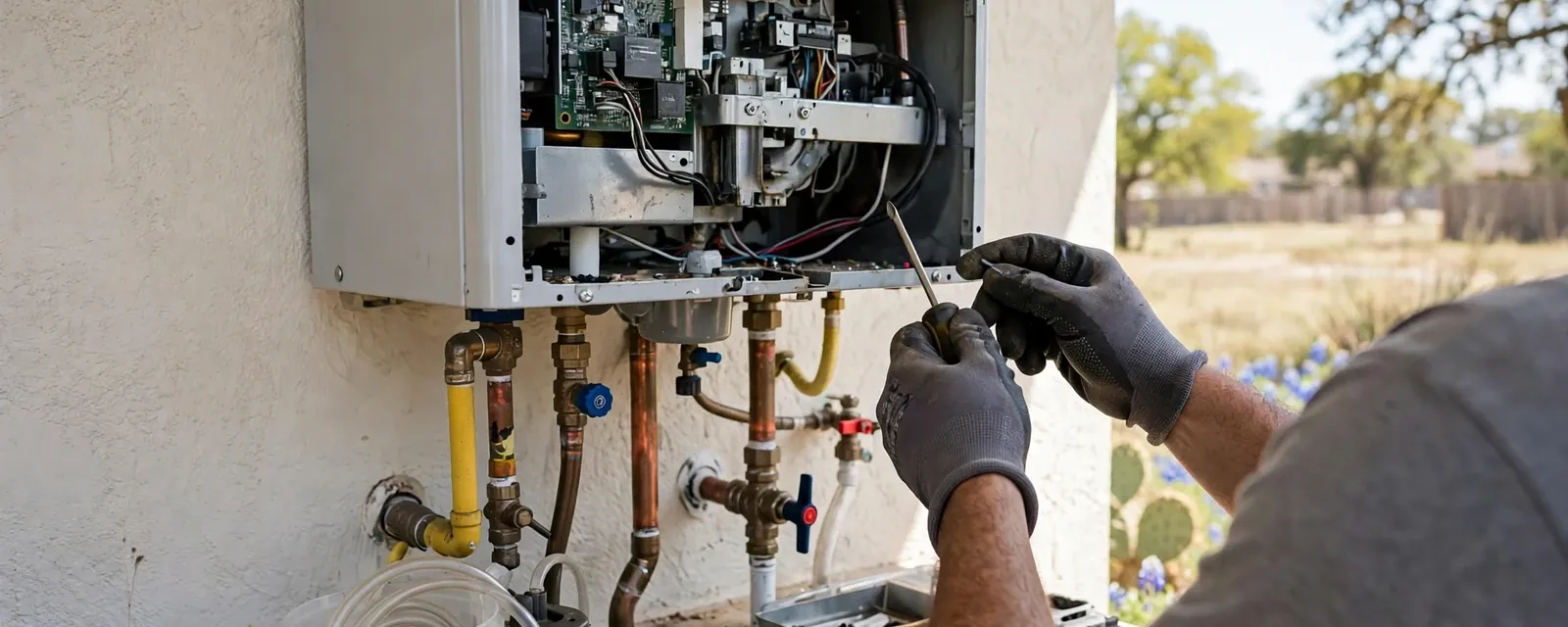
People often ask which tankless brand is best. We do not rank brands here, because the right choice depends far more on your house than on a logo. What we can do is show you the features that separate one model from another, so the conversation with any installer becomes concrete.
Well known makers such as Rinnai, Navien, Noritz and Rheem all sell on-demand units, and the names come up often in the Bay Area. Treat them as starting points for research, not as a verdict.
Start with the house, not the badge
Before comparing makers, three facts about your home decide which models are even possible. The first is the fuel: natural gas, propane or electric. The second is the route for venting and combustion air. The third is how much hot water you want at the same moment.
A unit that cannot be vented properly or fed by your gas line is the wrong unit, whoever made it. We check those basics first and only then compare models.
The features that actually differ
Condensing or non-condensing
A condensing gas unit squeezes extra heat from exhaust, runs cooler flue gas and usually vents through plastic pipe. It also produces acidic condensate that needs a drain and, often, a neutralizer. A non-condensing unit vents hot gas through metal and skips the condensate, but it uses a bit more gas.
Flow rate and temperature rise
Every model lists how many gallons per minute it can heat by a given number of degrees. Incoming water in the Bay Area is cool for much of the year, so check the flow figure at the temperature rise you actually need, not just the headline number.
Built-in recirculation
Waiting for hot water at a far bathroom is the most common complaint. Some models have a recirculation pump or a built-in buffer tank, and others rely on a separate pump. Ask what is included and what is an add-on.
Controls and connectivity
Remote panels, app control and error code displays vary. A clear code display helps a technician work faster. Fancy connectivity is nice, but a model you can diagnose easily matters more.
Parts and service access
Ask who stocks parts, how common the model is in your area, and how simple the flush ports are to reach. A unit that is easy to descale and easy to find parts for will cost less to keep running.
Gas, electric and what each asks of your home
Gas tankless heaters need a gas line large enough for the burner. Many older tank installs have a gas pipe sized for a smaller appliance, and upsizing the line is a real part of the job. Venting also needs correct clearances from windows, doors and neighboring structures.
Electric tankless heaters skip the vent and the gas, but they draw a large amount of electrical power at once, and many houses lack the panel capacity. In a home where the panel is already full, the gas version is often the more practical choice.
| Feature | Condensing gas | Non-condensing gas | Whole-home electric |
|---|---|---|---|
| Vent material | Plastic pipe | Stainless or similar metal | None |
| Condensate drain | Yes | No | No |
| Gas line demand | Large | Large | None |
| Electrical demand | Small | Small | Very large |
| Good fit | Newer builds, cost conscious on gas use | Simple swaps with existing metal vent path | Homes with strong panel, no gas |
Questions to ask any installer
Ask which model they recommend and why it fits your pipe sizes, your vent route and your usage. A good answer mentions specifics about your house, not a general claim that a model is the best. If the answer sounds like a brochure, push for details.
Ask what the plan is for scale control. Ask whether isolation valves for flushing will be installed, because they turn a hard annual job into an easy one. Ask what manufacturer coverage and installation terms apply, and get them from the maker's documents instead of from memory. Also ask who will handle service later, because a unit with no local service support is a risk even if it is well built.
Millbrae water and what it means for a tankless unit
Millbrae gets its water from the San Francisco Regional Water System, and the city's 2025 water quality report shows hardness from 8.1 to 112 ppm with an average of 62 ppm. That is on the soft side, which means less scale than many parts of California, but not none. A tankless heat exchanger has narrow passages, and even mild scale reduces flow over time, so a yearly flush is still worth doing.
The same report shows chloramine in the supply. When we plan a tankless install we look at the fittings and valves on the water side, since they all touch treated water. Millbrae also runs its own water system with 11 pressure zones, so pressure can differ from one street to another. We check static pressure before sizing anything, because pressure that is too low limits flow and pressure that is too high stresses the unit.
On the regulatory side, Bay Area air district rules on new water heaters are changing, including rules aimed at on-demand gas units. Ask us what applies to your replacement before you commit to a model. Permits may apply, and the Millbrae Building Division handles plumbing permits.
What not to rely on when you compare
Be careful with comparison charts that rank brands by a single score. Many are built from the ads of sellers, and they rarely account for your venting, your gas line or your water. A model that looks best on paper can be the wrong answer in your utility closet.
Be equally careful about reviews of a single unit that you read online, because they describe someone else's house. What carries over is the pattern: how easy the unit was to service, how clearly it reported faults, and how well the installer handled venting.
DIY or professional
DIY or what people try
- Buying a unit by name alone and expecting it to fit the old tank's gas line
- Reusing old vent pipe that is not rated for the new unit
- Skipping isolation valves, which makes later flushing a chore
- Ignoring the condensate drain on a condensing model
Professional approach
- Checking gas line size, vent route and clearances before choosing a model
- Setting water pressure and recirculation to suit the house
- Installing flush valves and a condensate path where needed
- Strapping, testing and pulling a permit where one applies
Want help comparing two specific models?
Send us the model names you are looking at, or tell us about your gas line and vent route, and we will compare them for your home.
How the choice usually ends up
For most Millbrae homes the decision comes down to venting and gas supply. If those are simple, many models would work and the deciding factors are recirculation, service access and how comfortable you are with the controls. If they are tricky, the house picks the model for you.
Our tankless water heater page explains the on-demand option in general, and our water heater installation crew can sort out where the unit will live, how it will be vented and what needs strapping. We also help in Burlingame through our Burlingame plumbing page, and the service area page shows where else we work. If your tank has already failed, the 24/7 line is open.
Tankless brand questions answered
There is no single best brand. The right unit depends on your fuel, your vent route, your flow needs and who can service it. We compare features against your house instead of ranking names.
Condensing models use less gas and vent through plastic, but they need a condensate drain and some upkeep. Non-condensing models are simpler and often easier to swap into an existing metal vent. Neither is better in every house.
Not always, but without one you wait for hot water to travel through the pipe. Some units have a built-in pump or small buffer tank. We look at the distance to your farthest fixture before deciding.
Sometimes, but many tank installs use a gas pipe sized for a smaller appliance. Tankless burners demand more gas at once, so the line may need upsizing. We check the size and the length of run before quoting.
Yes, though less often than in hard water. Even mild scale narrows the heat exchanger over time. Isolation valves make a flush simple, and our crew can add them during an install or swap.
They can. Millbrae's water system has 11 pressure zones, so pressure at your house may differ from a neighbor's. We measure static pressure before choosing a model, because low pressure limits flow and high pressure can stress the unit.
Sources and standards: The California Plumbing Code (based on the Uniform Plumbing Code). The City of Millbrae 2025 Water Quality Report. Brand names are examples only, with no ranking or rating implied.