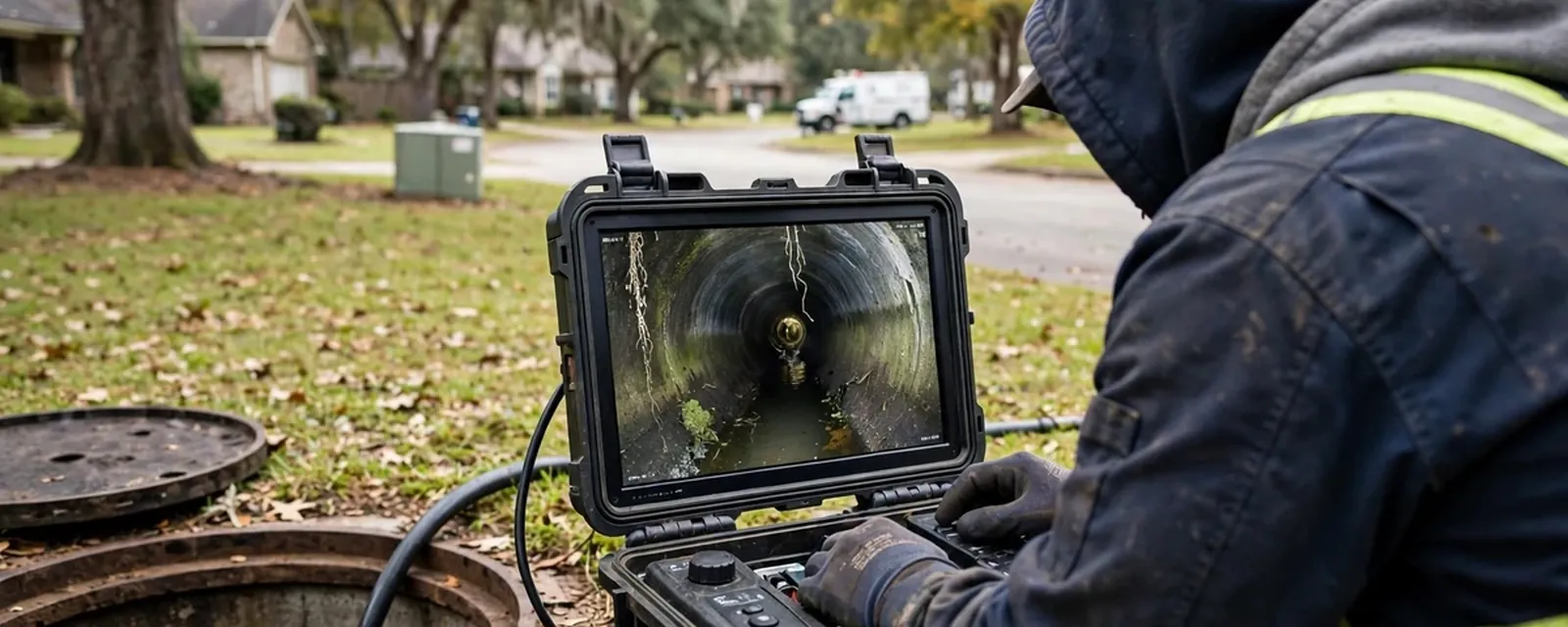
Trenchless repair is a family of methods that replace or rehabilitate an underground pipe without digging its whole length. The two you hear about most are cured-in-place lining and pipe bursting. Both work through small pits at the ends of the run, which is a big deal when the pipe passes under a driveway, a patio, mature landscaping or the sidewalk.
That said, trenchless is a tool, not a promise. Some pipes cannot be lined, and some failures need a spot dig anyway. The first job is to learn what the pipe really looks like inside.
Start with the camera, not the method
Nobody can pick a repair method from the symptom alone. A slow drain, a gurgle in a floor drain or roots reappearing every spring all point to a lateral problem, but not to which kind. A camera inspection records the pipe from the cleanout toward the main and shows cracks, offset joints, roots, belly sections that hold water and any collapse.
The recording also gives you something concrete to compare quotes against. If one company says the whole lateral needs replacing and another says a section will do, the footage is what settles it. Our sewer camera inspection service is built around exactly that step.
How the two main methods work
Cured-in-place lining
A flexible resin-soaked liner is pulled into the existing pipe, inflated against the walls and cured so it hardens into a new pipe inside the old one. It suits pipes that are still in line but cracked, leaking at joints or rough from age. It will not fix a collapsed section or a deep belly that holds water, because the liner follows whatever shape is already there.
Pipe bursting
A bursting head is pulled through the old pipe, breaking it outward while a new pipe is drawn in behind it. It can restore full diameter and even upsize slightly, and it handles pipes that are too far gone to line. The tradeoff is that it needs entry and exit pits, and nearby utilities and the surrounding soil have to be understood first.
| Question | Lining | Pipe bursting | Open trench |
|---|---|---|---|
| Pipe still in line? | Good fit | Works | Works |
| Collapsed or bellied section? | Poor fit | Often works | Often best |
| Digging needed | Small access points | Entry and exit pits | Full length |
| Surface disruption | Low | Moderate | Highest |
| Best for | Cracks, joints, roots | Failed pipe on a straight run | Short repairs, tricky geometry |
Local rules that change the plan
What the Millbrae sewer code asks of you
Under Chapter 8.20 of the Millbrae Municipal Code, the owner builds, maintains and clears the sewer lateral on their own lot. The city maintains only the part between the cleanout wye and the main, and only when the cleanout is in the designated location. So a root problem inside your property line is yours to fix, and the code gives you 120 days after notice to remove roots and repair the pipe to prevent a repeat.
Chapter 8.20 also ties lateral work to permits. A building permit that adds plumbing fixtures or enlarges more than 25 percent of a building calls for a camera inspection by a licensed plumber or sewer contractor first, and a lateral that fails must be repaired within 90 days. The code lists a backwater valve and relief valve among the items for qualifying work, so plan for them when you price a lateral job.
For buyers and sellers, the code also describes lateral testing at the time of sale for buildings more than 20 years old. The exact enforcement status depends on the city's current program, so call Public Works before assuming it applies or does not. If a camera inspection shows a lateral failing, the repair method you choose should be one the city will accept.
When trenchless is a poor idea
Trenchless methods struggle where the pipe has fallen apart, where the slope is wrong or where a large belly collects waste. Lining over a belly just creates a nicely coated trap. A pipe with several sharp offsets can be difficult to burst or line without cutting access points along the route.
There is also a practical issue with ground conditions. Millbrae's general plan notes that the San Andreas Fault lies within a mile of the western city limits, and some areas near the Bay are designed against liquefaction and subsidence. Soil that moves can break a lateral at one point, and a spot dig and joint repair may be the cleaner answer than lining a pipe that will shift again.
Before anyone digs anything
Anywhere a pit will be opened, underground utilities must be marked first. USA North 811 requires at least two working days of notice before excavation starts, so build that time into the schedule. Gas, electric, water and communication lines can all share the same corridor as the lateral.
Camera inspection and mapping
We run a camera from the cleanout, note distances to defects and mark the path on the surface. This is the step that decides everything else.
Method choice and permit check
We explain whether lining, bursting or a spot repair fits, and what the Millbrae Building Division may need for the work.
Access, repair and testing
Small pits are opened, the repair is made, and the line is tested. A final camera pass confirms the pipe is clear and continuous.
What drives the price of a trenchless job
We do not quote prices in a blog post, because the camera footage changes everything. The factors are the length of the lateral, its depth, the number of access pits, the pipe diameter, the repair method and what sits above the pipe. Restoration of paving or landscaping is another real line item.
What moves the price of trenchless repair
The price comes from what is found in the pipe and what sits above it, not from the method name.
Length and depth
A longer or deeper run takes more time and equipment.
Number of access pits
Each pit means digging, shoring and restoration.
Condition of the pipe
Collapse or severe belly can rule out lining and change the plan.
Surface restoration
Concrete, pavers and landscaping above the line add work.
Permit and inspection needs
The city's lateral rules can add steps before and after.
Call the 24/7 line for a clear price before work starts. Insurance coverage for sewer lateral work varies, so check your own policy.
Hiring someone for this work
Plumbing work that needs a permit is not covered by the California minor-work exemption, which is limited to very small jobs and does not apply when a permit is required. The Contractors State License Board lets you verify a contractor's license, and a C-36 is the plumbing classification. It is worth a two-minute lookup before anyone starts cutting.
Where to go from here
If you are comparing repair paths, our sewer line repair service covers lining, bursting and spot digging, and every job begins with the camera. We also work with neighboring homeowners, and the Burlingame plumber page shows how we serve the next town over.
For a wider view of where we work, the service area page lists nearby towns and ZIP codes. A backed-up lateral at midnight is no time to compare methods, so keep the 24/7 line in your phone.
Think your lateral is failing?
Call the 24/7 line and describe the symptoms. We will talk through a camera visit and what trenchless options may be on the table.
Not always. It saves restoration cost when the pipe runs under hard surfaces or landscaping, but a short, shallow repair can be simpler with a spot dig. The camera footage and the surface above the pipe decide which is better value.
Most jobs fit in a day or two once access pits are ready, though prep, utility marking and permits come first. A bursting job and a lining job have different time profiles, so ask for the schedule after the camera inspection.
A good liner seals joints and cracks where roots usually enter, which makes recurrence less likely. Roots can still push at connections and cleanouts, so keep an eye on slow drains and plan periodic checks.
Often yes when the pipe is still roughly in line, since lining can restore a rough interior and bursting can replace a failed run. We do not assume what your pipe is made of until the camera shows it.
Permits may apply, and the Millbrae Building Division handles plumbing permits. Chapter 8.20 also has lateral inspection requirements tied to certain permits and sales, so ask us and Public Works before the job begins.
Under Chapter 8.20, the owner is responsible for the lateral on the lot, while the city maintains the portion between the cleanout wye and the main when the cleanout is in the designated location. Where your cleanout sits changes who owns a repair near the curb.
Sources and standards: Millbrae Municipal Code chapter 8.20 on sewer laterals. The California Plumbing Code (based on the Uniform Plumbing Code). USA North 811. Which asks for at least two working days' notice before Northern California excavation.